Computational Biophysics · AI · Experiments
Understanding the molecular origins of neurodegenerative diseases
We combine AI and physics-based modeling, molecular simulations, and biophysical/biochemical experiments to uncover the molecular mechanisms, transition states, and critical seed structures that drive neurodegenerative protein aggregation.
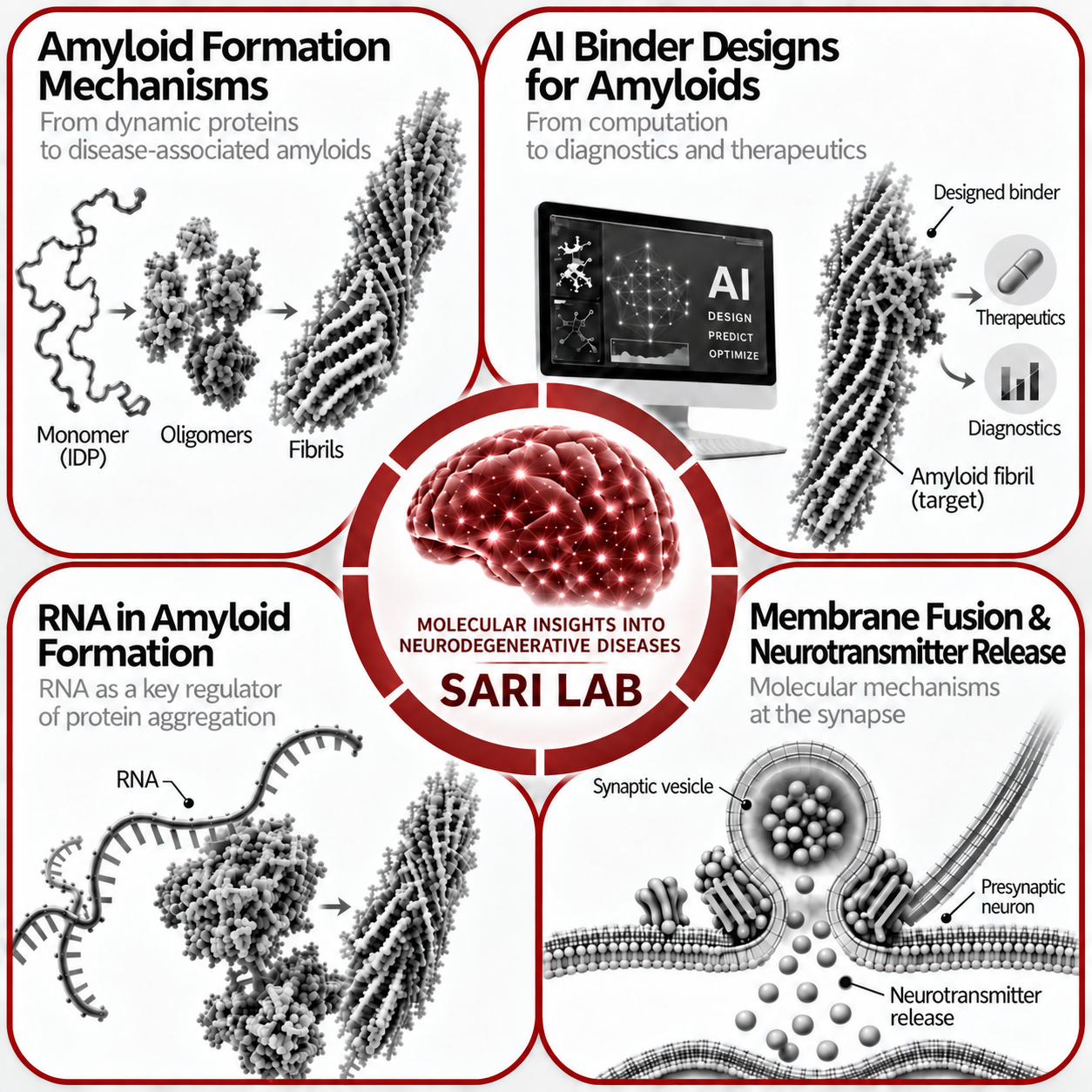
Research directions
From molecular mechanisms to molecular design.
Our work connects physics-based molecular simulations, modern AI methods, and targeted biochemical and biophysical experiments.
Amyloid Formation Mechanisms
We investigate the molecular events that drive nucleation, oligomerization, fibril formation, and disease-associated structural polymorphism in tau, amyloid-β, α-synuclein, and related amyloid-forming proteins.
Explore →02AI Binder Designs for Amyloids
We use AI-guided protein, peptide, and ligand design to develop binders that recognize disease-relevant amyloid structures for potential diagnostic and therapeutic applications.
Explore →03RNA in Amyloid Formation
We investigate how RNA interacts with intrinsically disordered and amyloid-forming proteins and how these interactions influence aggregation pathways and fibril formation.
Explore →04Membrane Fusion & Neurotransmitter Release
We study the molecular mechanisms of synaptic membrane fusion and the protein interactions that control neurotransmitter release.
Explore →Our approach
Physics + artificial intelligence + experiment
Protein aggregation and other complex biological processes involve dynamic molecular systems that cannot be understood from a single static structure.
We combine atomistic molecular dynamics simulations, enhanced sampling, free-energy calculations, AI-based molecular design, and experimental validation to characterize transient molecular states and interactions.
Our goal is to uncover fundamental molecular mechanisms and translate these insights into new diagnostic and therapeutic strategies for neurodegenerative diseases.
Read about our research →Opportunities
Interested in joining the Sari Lab?
We welcome inquiries from postdoctoral researchers, graduate students, undergraduate students, and collaborators interested in computational and experimental biophysics, protein aggregation, molecular simulation, and AI-based molecular design.
View opportunities